Home > Products > SWF to Video Converter Pro > Tutorial

How to convert swf to video with Moyea SWF to Video Converter Pro

swf converter - convert swf to video, swf to avi
Price: $99.95

Buy swf to video converter pro Free swf to video converter pro download
Free trial download

Are you a captive of the engaging Macromedia Flashes? Do you want to play them on your computer or potable devices? If so, come with Moyea SWF to Video Converter,and you will find it easy and simple to access:

Download Moyea SWf to Video Converter Pro software on http://www.swfkits.com/swf_to_video/ and install it on your computer. OK, let’s start

1. Input Flash Files:
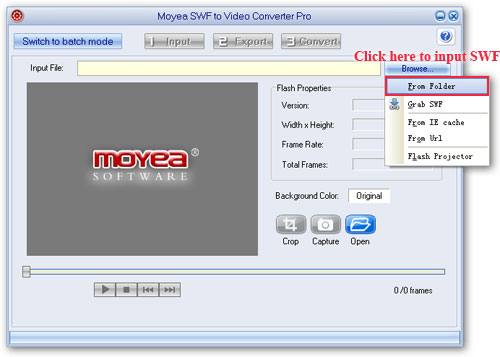
①Click “Browse…”tab to input flash files from your computer folder. Click “V” immediately behind, a drop list will cascade automatically. Choose among “From Folder”, “From IE cache” and “Flash Projector”, and there will be a dialog box accordingly pops up. Choose files in those dialog boxes and click “OK”. On the right of pane are the properties of current playing flash.

Tips: On opening the window, you will get “Single Mode” conversion, if you have many files to convert, you are suggested to choose “Batch Mode” on the top left.

Imput swf files into swf to video converter Pro


2. Capture Pictures
Click “Original” in Background Color box, there will pop up a pigment pane, you can select one color or just DIY a color for your video background. Click “Camera” tab to capture pictures of the playing flash, and captured image files will be saved as JPEG format files. Click “folder” on the right to check for its saving folder. You can click the button continuously for pictures, and check them together. Click “Crop” in menu to crop video.


capture pictures

3. Crop Video
Click the button “Crop” and the following interfaces will pop up.

Crop video. Crop video size by changing the values on the right of pane. Choose “Select All”, generated video will keep the original size. Or simply move your mouse cursor on the video pane to make it.

Add image water mark. Check the “Add image water mark” box to add an image to video. Click “Folder” immediately behind to browse for image from your folder. Click “None” in the box to set the transparency of your image. “None” is for no editing, and on clicking “Select…” , there will be a dialog box pops up automatically.

Edit image. Set RGB values to DIY a color, showing in the bar below. Drag tolerance bar, you can easily get the picture altered in pixel; drag Alpha bar to adjust opacity of the picture. Click “OK” to continue.

Set image position. Place the position of your image by changing values on the right side. Click the lock in the core, then you can set one certain value without changing other values.


Crop video

watermark


4. Export Settings
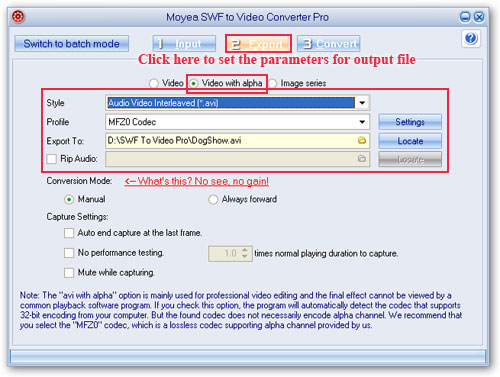
Click “Export” tab in menu, and you will get the following windows.

Profile selection. Click “AVI—Audio Video Interleaved (*.avi )” under the “ Profile”, and a drop list will cascade. Select your export file format from it.

Note: By selecting the “avi with alpha” option, you are suggested to take a look at the “Note” on the bottom for details about this format.

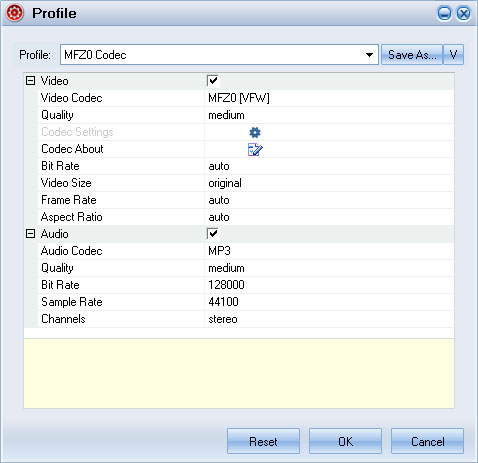
Tips: On choosing your export file format from drop list, the table on the right will change in accord. Change the video and audio parameters by clicking each item and selecting the value. Click “Save as” immediately after the box to save the profile you set as a new one. Click “V”, you can save, rename, or delete the newly set.

Set the export destination folder. Click the folder in the “Export to” box to set the output destination, and click the “Locate” button, the destination folder will pop up immediately.

Rip the audio. Check the “Rip Audio” box, and the audio will be extracted and generated as a single file. Click the “folder” on the right to browse for the audio destination folder, and click the “Locate” button, the destination folder will pop up itself.

Select conversion mode. Click the "▼” in the Conversion Mode box to decide the conversion mode.  By selecting “Manual”, you can interact in the conversion process by setting the capture start and end points while selecting “Automatic” mode, the conversion will process automatically.

Note: The manual mode conversion can help guarantee a better result. It is highly recommended for the interactive or Ascript controlled flashes with few frames.

Click the “Convert” tab in the menu to convert the files.


5. Conversion
Click “Convert” in the menu, there will be the interface for you to set the working folder. Set the working folder or just keep the default. To guarantee an accurate result, you are suggested to interact with the flash when it asks you to.


Click “Next”, you will get a flash clip, which is the testing of the screen capturing speed. After a second, you will get the following window for you to set the screen capturing speed. Set the speed, or just keep the default. Click “Next” to continue. Check the “Mute while capture” box for silent capture.


Click “Start Play”, the program will play the flash, during the playing , click “Capture” button to set the beginning frame, and click “Finish” button to set the end frame in the bottom toolbar. Click “Start Capture”, the program will capture with the very first frame.


Then, the encoding process starts, and after a while, the conversion will complete. Confirm the “Conversion Success” and the output folder will pop up automatically. Now the rest is to enjoy your fancy!


Well, the above instructions are for the single mode, and the converter can also convert files in batch mode in a much easier way, for it consists of only three steps!

On Opening the software, you will get this window for single mode conversion, click “Batch Mode” on the top left to shift to the batch mode conversion.


1. Files Input.

All are the same with the single mode files inputting, except that you can click each file name to play in the dialog box, and then select the check box before the items you want to convert. Of course , you can click “Check All” to select all, “Uncheck All” to delete all the selected. Choose “Invert” for the items selected. Then, click “OK” to confirm. Click each file name to play, during the playback, click the “Camera” to capture a picture, and the “Folder” to check the saving folder.

Click “Export” in the menu for the export settings.

Note: As batch mode is default with the automatic conversion mode, some of the interactive or AScript controlled flashes with few frames may not be processed perfectly. It is recommended to shift this kind of files to “Single Mode” to convert under “Manual Mode” for a better result.


2. Export Settings
All the same to the “Single Mode”, except that you don’t have to select conversion mode, as batch mode is default with automatic conversion.


Then the program will move on to test the screen capturing speed, and encode one by one. Through this process, you can only set the end frame of each file by clicking the “Finish” button in the bottom toolbar.

Now, the conversion is completed. Confirm the “Conversion Success” and the output folder will pop up automatically. Now the rest is to enjoy your fancy!

Awards for Moyea SWF to video converter